
Staircases · Balustrades
Balustrades, handrails and spindles, made and fitted in Dorset
Replace the banister and keep the stair: new handrails, spindles and newel posts, made in our Poole workshop and fitted by our own joiners.
Replacing the banister is often all a staircase needs. The flight stays; the parts your hand touches are made new: the handrail, the spindles and the newel posts. We make handrails, newels and timber spindles in our Poole workshop, or pair an oak handrail with black metal spindles, and our own joiners fit the new balustrade across Dorset.
Banister, bannister, balustrade: the words overlap. All of them mean the guarding up the side of a stair and along the landing — the handrail on top, the spindles or balusters beneath it, and the newel posts that anchor it at the ends and the turns.
Every part is drawn for your stair, made in our workshop in Poole and fitted by the same joiners, so one team is responsible from the survey to the final finish. If the treads and risers need work too, see staircase renovation; for a complete new flight, see bespoke staircases.
What we make and fit
Balustrades & handrailsReplacing a banister: what stays and what is new
At the survey we look at the whole stair and landing. Where the strings, treads and newels are sound, they stay, and only what has worn or dated is replaced: often the handrail and spindles, sometimes the newels too.
The new parts are made for the stair as it is, which is rarely perfectly true, and fixed into its structure rather than just to the surface. We work cleanly, and keep the stair and the floor around it covered until the job is done.
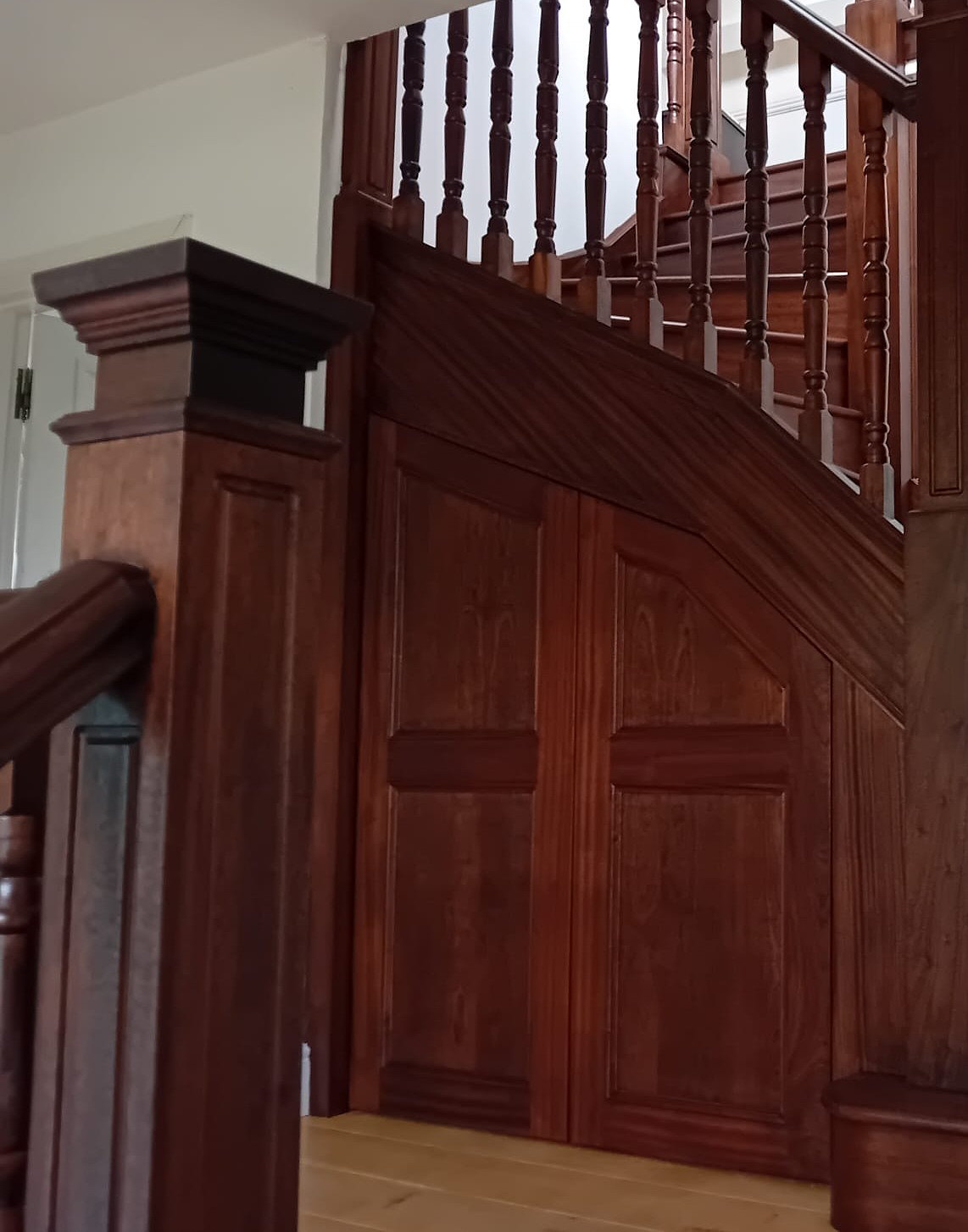
Turned spindles and panelled newels
A traditional balustrade: turned spindles, a heavy panelled newel and a moulded handrail, here in mahogany, made at the bench and matched to the period of the house.
Where an old stair has lost spindles, new ones can be turned to match the originals. See our heritage joinery.
Mahogany staircase
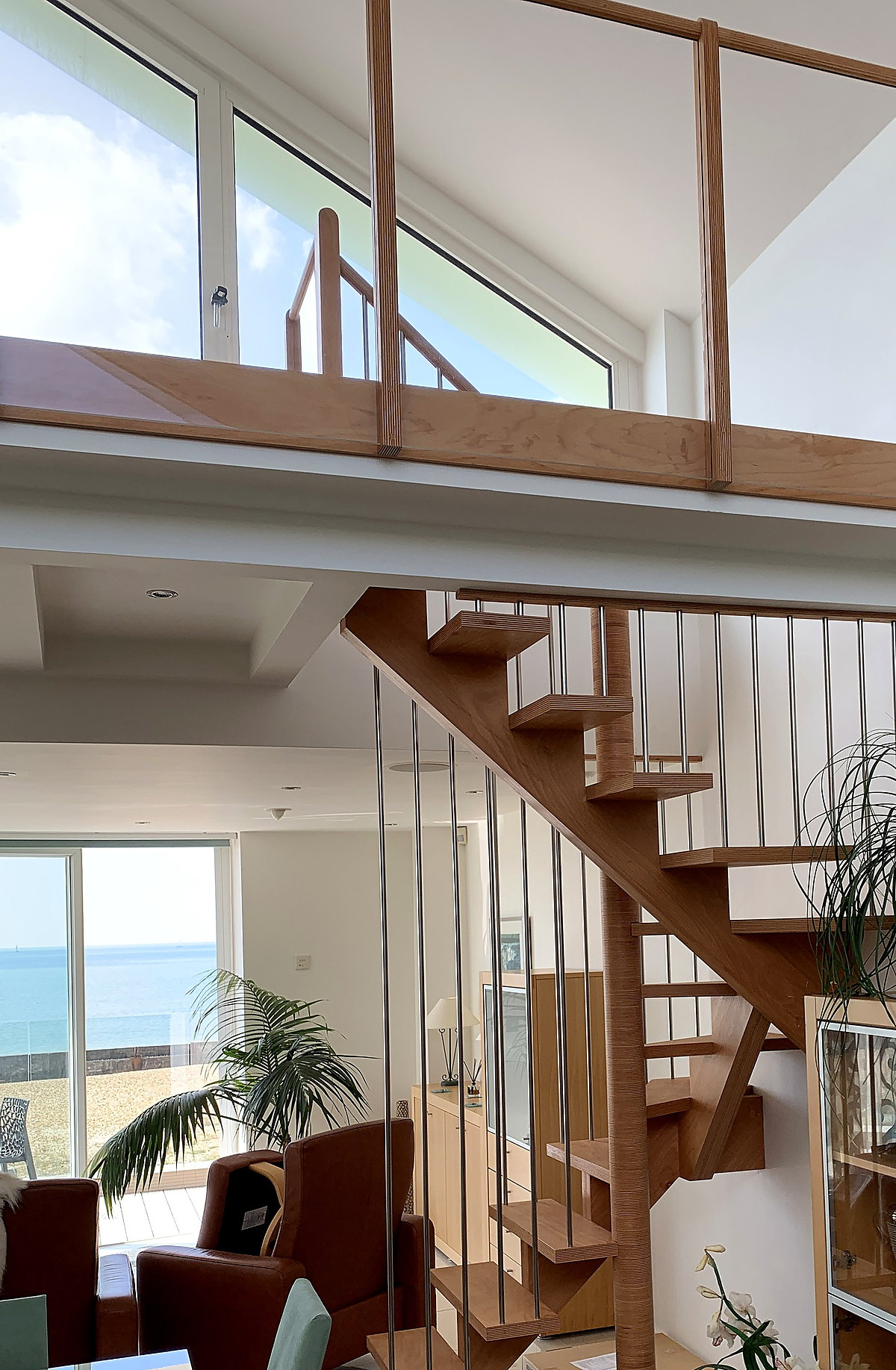
Slim metal balusters
Slim metal balusters keep a stair open to the light. On this open-tread oak staircase in Milford on Sea, the treads, strings and balustrade were drawn and made together, so the stair reads as one clean line.
On an existing stair, a continuous oak handrail over black metal spindles gives much the same openness.
Oak staircase · Milford on Sea
Replacing a glass balustrade
A stainless steel and glass balustrade can come out and be replaced with an oak handrail and slim black metal spindles, or with timber spindles. Glass keeps a hall open and light, but it can feel cold and shows every fingerprint; an oak handrail is warm under the hand, and slim black spindles keep much of the openness.
At the survey we look at how every post and glass channel is fixed, because each fixing leaves a mark when it comes out. The glass comes out one panel at a time, and the holes are filled, covered by the new base rail or capping, or hidden under new treads if the stair is being renovated at the same time.
Matching a period balustrade
In a period house the balustrade is part of the character of the hall. We match new work to what is there: spindles turned to the old pattern, a handrail run to the old profile and newels made to suit, so the repair cannot be picked out. See heritage, listed & conservation joinery.
Height and spacing: what the regulations ask
New balustrades are drawn to Approved Document K, the government guidance on stairs and guarding. In a house, the top of the handrail sits between 900 mm and 1,000 mm above the pitch line of the stair, and the guarding on stairs and landings is at least 900 mm high.
Where a home may be used by children under five, no gap in the balustrade should let a 100 mm sphere through, and it should not be easy to climb, so the spindles are spaced for your stair rather than to a pattern. You can read the guidance on GOV.UK.
How a project runs
From photos to the final fitCommon questions
Balustrades & handrailsHow much does it cost to replace a banister?
It depends on the length of the stair and landing, the number of spindles and newels, the timber, whether the handrail is continuous or runs post to post, any curved or wreathed sections, and how much making good the old balustrade leaves. We give a guide price from photos and rough sizes before we visit, and a fixed price after the survey.
Can you keep my handrail and change the spindles?
Often, yes. If the handrail and newels are sound and you like them, new spindles in timber or black metal can be fitted between them. We check at the survey that the handrail and its base will take the new spindles, and say so if a new handrail would be the better job.
Can you replace a glass balustrade with oak?
Yes. The glass, posts and fixings come out, the holes are filled or covered, and a new oak handrail, newels and spindles are fitted, drawn to the Building Regulations guidance.
What is a continuous handrail?
A handrail that runs unbroken from the bottom of the stair, over the newel posts and along the landing, instead of stopping at each post. It is shaped to every turn and change of pitch, so your hand never has to let go.
How far apart should stair spindles be?
Close enough that a 100 mm sphere cannot pass between them. Approved Document K asks for this in any home that may be used by children under five, so it is the spacing we work to.
What height should a stair handrail be?
Between 900 mm and 1,000 mm above the pitch line of the stair, measured to the top of the handrail. In a house, the guarding on stairs and landings should be at least 900 mm high.
Further reading
Where we work
Balustrades & handrails for homes in Poole, Sandbanks, Canford Cliffs, Branksome Park and Bournemouth — and across Dorset, the New Forest & Hampshire.
By appointment
Arrange a consultation.
Send us a few photos of your staircase and landing, with rough sizes if you have them. We’ll come back with a guide price, then visit to survey. No obligation.